The Chameleon's Limit
Validity of simulated populations
Do distinct persona profiles produce behaviorally diverse populations?
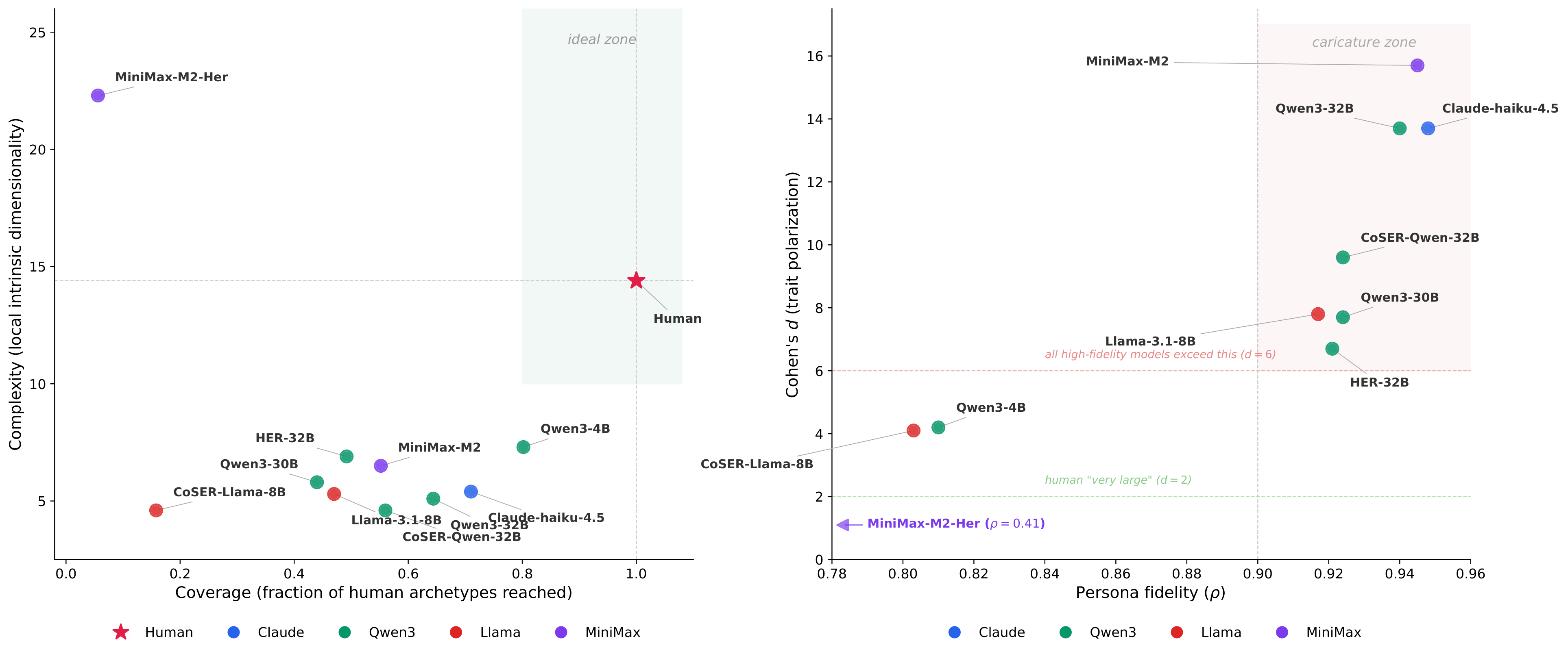
High persona fidelity can coexist with a homogeneous simulated population: convincing individuals do not guarantee population diversity.
What we studied
We evaluate 10 language models and 1,144 personas across personality responses, moral judgments, and self-introductions.
My contribution
Co-first author.
How to read the result
The findings concern the tested models, personas, and evaluation tasks. The illustration below uses synthetic data to explain persona fidelity and population diversity.
Paper & authors
-
The Chameleon's Limit: Investigating Persona Collapse and Homogenization in Large Language Models [W4]
High persona fidelity can coexist with a homogeneous simulated population: convincing individuals do not guarantee population diversity.
2026. arXiv:2604.24698.
Same profiles. Different populations.
Can simulated people match their profiles and still sound alike? Explore two different things an evaluation might measure.
Illustrative model. 24 synthetic people, no live LLM, no experimental scores from the paper.
Do the profiles match?
Do the responses vary?
Matching explicit profile attributes does not by itself establish diversity in other behaviors. These two properties need separate evaluation.
What this illustration assumes
The two controls are independent by construction. Profile fidelity changes the distance from 24 fixed target preferences; response diversity changes the spread of a separate, unspecified behavior. The axes are unitless and synthetic. This is a counterexample to treating fidelity as sufficient evidence of diversity, not a claim that the two are independent in real models.